
Geoffrey Hinton
 Toronto, ON

Early life
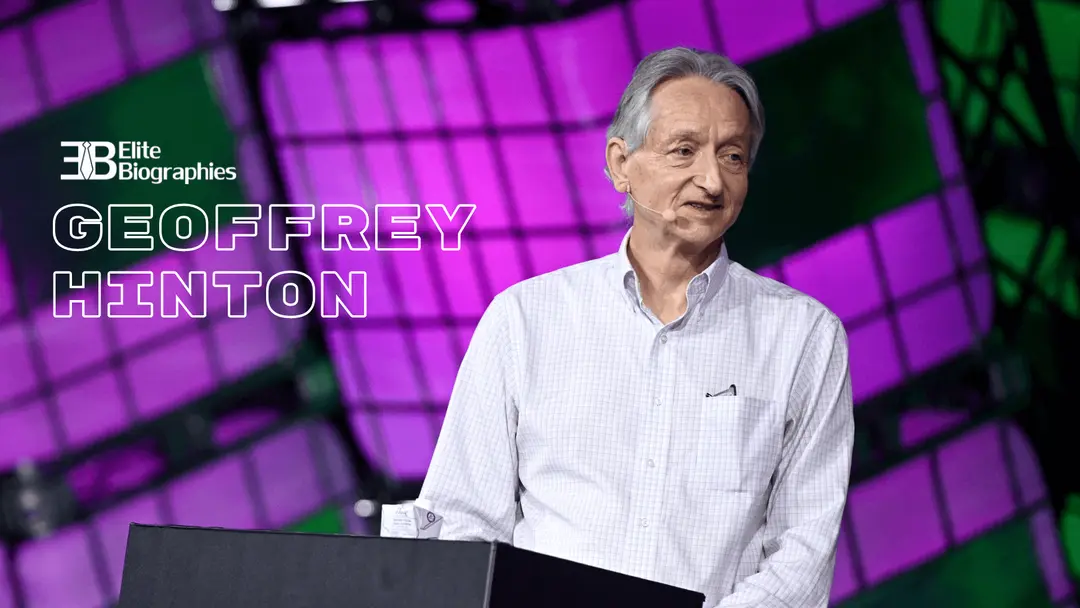
Born in Wimbledon, England in 1947, Geoffrey Hinton received his early education at Clifton College in the city of Bristol.
As a young man, he enrolled in the prestigious King’s College at Cambridge University, where he experimented with studying several different disciplines, including natural sciences, history of art, and philosophy. He would ultimately graduate with a Bachelor of Arts degree in Experimental Psychology, after which he would take a gap year to apprentice as a carpenter before returning to academia. Beginning in 1972, Hinton continued his studies at the University of Edinburgh in Scotland, earning a Ph.D. in artificial intelligence in 1978. He then went on to complete his postdoctoral work at Sussex University and the University of California San Diego.

Career
Beginning in 1983, Geoffrey Hinton served a five-year appointment in the Computer Science department at Carnegie Mellon University. In 1985, he co-invented Boltzmann machines using tools from statistical physics, a foundational contribution to neural network research and one of the signature accomplishments of his career.
In 1987, Hinton moved to Canada, joining the University of Toronto (U of T) and becoming a fellow of the Canadian Institute for Advanced Research (CIFAR) in its inaugural Artificial Intelligence program. From 1998 to 2001, he served as founding director of the Gatsby Computational Neuroscience Unit at University College London.
In 2004, he co-launched and later led CIFAR’s “Neural Computation and Adaptive Perception” program (now known as “Learning in Machines & Brains”) for a decade, fostering collaboration among future luminaries and notable figures such as Yoshua Bengio and Yann LeCun.
Starting in 2006, Geoffrey Hinton was tapped to become a full professor at U of T, and his research group at that institution would go on to achieve major breakthroughs in deep learning, transforming speech recognition and object classification. During this time, he advanced distributed representations, time-delay neural networks, mixtures of experts, Helmholtz machines, and deep belief networks, each instrumental in establishing the foundations for modern deep learning.
In 2008, Hinton co-developed the t-SNE visualization method, which maps high‑dimensional data into two‑ or three‑dimensional spaces to reveal structure at many scales. In 2012, he co-founded DNNresearch Inc. alongside two graduate students. The organization’s work revolved around developing deep neural networks for voice recognition, image recognition and other machine‑learning applications. It was acquired by Google the following year. In 2017, he became Chief Scientific Advisor at the Vector Institute in Toronto. More recently, Geoffrey Hinton has focused on new architectures and algorithms, including the GLOM framework and the Forward-Forward algorithm, and has explored “mortal computation” and brain-inspired generative models.
Until his resignation in 2023, Hinton split his time between his university research and work at Google, later becoming a vocal commentator on the risks of artificial intelligence.
Over the course of his career, Hinton has been recognized with numerous honors for his work in artificial intelligence and neural networks. He has been named a Fellow of the Association for the Advancement of Artificial Intelligence (AAAI), the Royal Society of Canada, and the Royal Society of London, and has received lifetime-achievement awards such as the International Joint Conference on Artificial Intelligence Award for Research Excellence and the Herzberg Canada Gold Medal. He has received several honorary doctorates from post-secondary institutions of note, and in 2018, he shared the Turing Award with Yann LeCun and Yoshua Bengio. Hinton has also received awards like the Princess of Asturias Award, the VinFuture Prize, the Queen Elizabeth Prize for Engineering, and the King Charles III Coronation Medal.
In 2024, Geoffrey achieved one of the highest accolades science has to bestow when he won the Nobel Prize for Physics, sharing the honour with John J. Hopfield.
He is presently a Professor Emeritus at U of T.

Net Worth
Information pertaining to Geoffrey Hinton’s net worth has not been publicly disclosed.

Achievement
 Earning a Ph.D. in artificial intelligence from the University of Edinburgh in 1978.
Co-inventing Boltzmann machines in 1985.
Becoming a fellow of the Canadian Institute for Advanced Research (CIFAR) in its inaugural Artificial Intelligence program in 1987.
Serving as founding director of the Gatsby Computational Neuroscience Unit at University College London from 1998 to 2001.
Receiving the Rumelhart Prize in 2001 for contributions to theoretical and computational cognitive science.
Co-launching and leading CIFAR’s “Neural Computation and Adaptive Perception” program from 2004 until 2014.
Receiving the International Joint Conference on Artificial Intelligence Award for Research Excellence in 2005 for lifetime contributions to the development of AI.
Being named a full University Professor at the University of Toronto in 2006.
Co-developing the t-SNE visualization method in 2008.
Receiving the Herzberg Canada Gold Medal for Science and Engineering in 2011.
Co-founding DNNresearch Inc. in 2012.
Co-founding the private, nonprofit Vector Institute in 2017 and becoming its chief scientific advisor.
Winning the Turing Award in 2018, jointly with Yann LeCun and Yoshua Bengio, for foundational work in deep neural networks.
Receiving the VinFuture Prize Grand Award in 2024 for breakthroughs in neural networks and deep learning, alongside Yoshua Bengio, Yann LeCun, Jen-Hsun Huang, and Fei-Fei Li.
Winning the Nobel Prize for Physics in 2024, an honour he shared with American physicist John J. Hopfield.
Receiving the Queen Elizabeth Prize for Engineering in 2025, jointly with Yoshua Bengio, Bill Dally, John Hopfield, Yann LeCun, Jen-Hsun Huang, and Fei-Fei Li.
Receiving the King Charles III Coronation Medal in 2025.
Earning a Ph.D. in artificial intelligence from the University of Edinburgh in 1978.
Co-inventing Boltzmann machines in 1985.
Becoming a fellow of the Canadian Institute for Advanced Research (CIFAR) in its inaugural Artificial Intelligence program in 1987.
Serving as founding director of the Gatsby Computational Neuroscience Unit at University College London from 1998 to 2001.
Receiving the Rumelhart Prize in 2001 for contributions to theoretical and computational cognitive science.
Co-launching and leading CIFAR’s “Neural Computation and Adaptive Perception” program from 2004 until 2014.
Receiving the International Joint Conference on Artificial Intelligence Award for Research Excellence in 2005 for lifetime contributions to the development of AI.
Being named a full University Professor at the University of Toronto in 2006.
Co-developing the t-SNE visualization method in 2008.
Receiving the Herzberg Canada Gold Medal for Science and Engineering in 2011.
Co-founding DNNresearch Inc. in 2012.
Co-founding the private, nonprofit Vector Institute in 2017 and becoming its chief scientific advisor.
Winning the Turing Award in 2018, jointly with Yann LeCun and Yoshua Bengio, for foundational work in deep neural networks.
Receiving the VinFuture Prize Grand Award in 2024 for breakthroughs in neural networks and deep learning, alongside Yoshua Bengio, Yann LeCun, Jen-Hsun Huang, and Fei-Fei Li.
Winning the Nobel Prize for Physics in 2024, an honour he shared with American physicist John J. Hopfield.
Receiving the Queen Elizabeth Prize for Engineering in 2025, jointly with Yoshua Bengio, Bill Dally, John Hopfield, Yann LeCun, Jen-Hsun Huang, and Fei-Fei Li.
Receiving the King Charles III Coronation Medal in 2025.
Elite Biographies Features


Related Bios
David Hofstedter
Rabbi David Hofstedter is a Canadian real estate investor, entrepreneur, and philanthropist based in Toronto. He founded...
Read More
Christopher Dardarian
Christopher Dardarian is a Canadian landscape designer, horticulture professional, and entrepreneur. He is best known as...
Read More
Stan Bharti
Stan Bharti is a prominent Canadian businessman and professional engineer with over 30 years of experience in mining, te...
Read More
York University
York University (commonly referred to as YorkU) is Canada’s third-largest university, renowned for its commitment to a...
Read More