



Early life
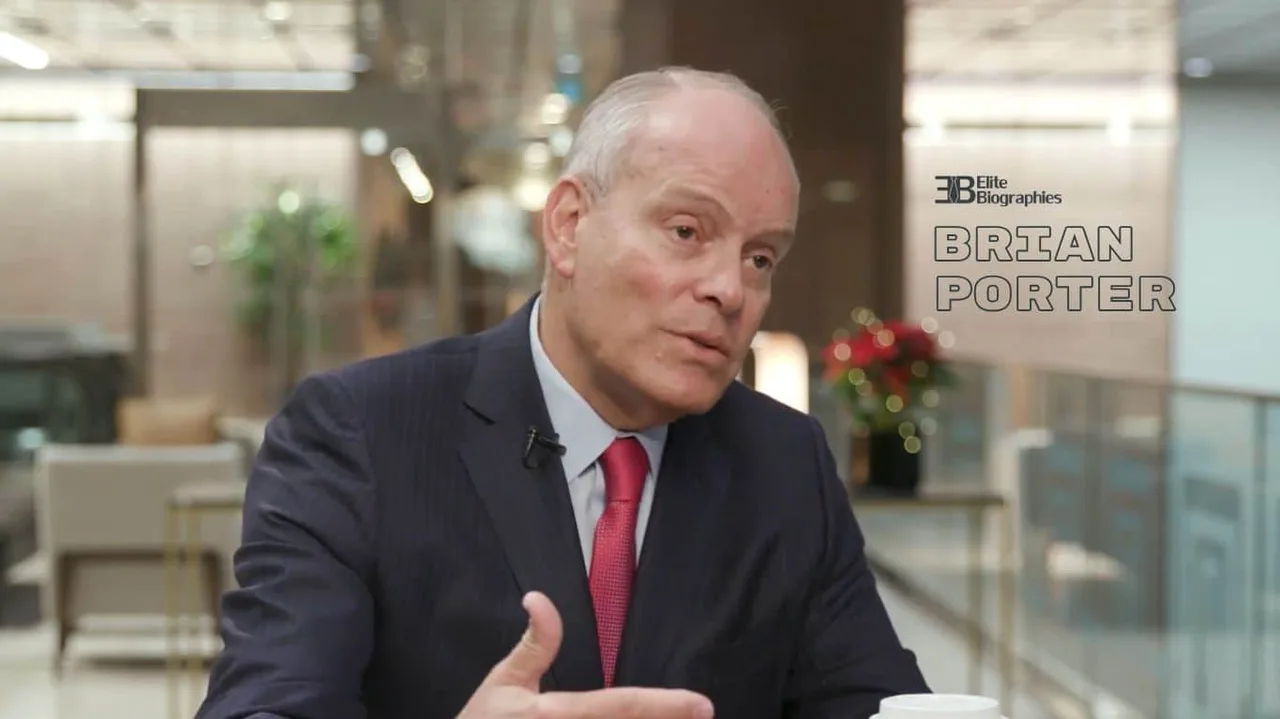
Brian Porter was born in Calgary, Alberta, on February 9, 1958, to Johnston Donald Porter and Shirley Ann Wright. In 1980, he graduated from Dalhousie University with a Bachelor of Commerce degree. He began his career in 1981 at an investment brokerage firm called McLeod Young Weir. His path ahead was promising at McLeod: in just five years, he rose to VP by 1986. In December 1987, McLeod Young Weir was acquired by Scotiabank and rebranded as ScotiaMcLeod, marking the start of Porter’s long employment with the bank. His early start in investment brokerage and institutional equities provided the foundation for a career in banking leadership.

Career
Following the acquisition with Scotiabank, Brian Porter set out on what would become a decades-long career within one of Canada’s largest financial institutions. His leadership trajectory began to accelerate in 1988 when he was elected a director of ScotiaMcLeod, the bank’s investment arm. Just two years later, he was named senior VP, reflecting his growing influence within the firm and recognition of his knowledge of capital markets.
In the mid-1990s, Porter’s responsibilities grew. By 1996, he was appointed Managing Director of Institutional Equities, a key position that placed him at the center of Scotiabank’s investment strategy and relationship management with major institutional clients.
In 1998, Porter completed the Advanced Management Program at Harvard Business School—an internationally respected executive program designed to augment the skill sets of top-tier leaders and prime them for elite success. This educational milestone prepared him for broader strategic leadership and strengthened his global perspective, both of which would become crucial in later roles.
From 2006 to 2008, he served as Executive Vice-President and Chief Risk Officer at Scotiabank. This was a particularly important position during a period of growing global financial complexity. Porter was instrumental in improving the bank’s risk management framework, helping the institution better identify, assess, and mitigate financial risks across international operations. His work laid the foundation for Scotiabank’s ability to stay resilient through periods of economic uncertainty, including the sub-prime mortgage crisis of 2007 and ensuing global financial crisis that gripped the world in 2008.
Between 2008 and 2010, Brian Porter transitioned to the role of Group Head of Risk and Treasury, a role that merged oversight of two of the bank’s most sensitive areas: global risk and capital funding. His leadership during this period demonstrated his capacity to manage both strategic risk and liquidity—a balancing act critical to any large financial institution, especially in the aftermath of the global financial crisis.
From 2010 to 2012, Porter served as Scotiabank’s Group Head of International Banking. In this position, he managed the bank’s operations in various international markets. With his leadership, the bank pursued strategic expansion into regions like Latin America and the Caribbean, focusing on sustainable growth, local partnerships, and regulatory compliance. His experience with international markets would become a defining aspect of his leadership style as CEO.
On 1 November 2012, Porter succeeded longtime executive Rick Waugh as President of Scotiabank, and exactly one year later, on 1 November 2013, he assumed the role of Chief Executive Officer. As CEO, he was known for his disciplined management style, focus on long-term strategy, and commitment to innovation in financial services. He pushed forward a more streamlined, customer-focused business model, investing in digital banking capabilities and restructuring operations to increase efficiency.
Under Brian Porter’s stewardship, Scotiabank grew significantly, nearly doubling assets under management and substantially enhancing the brand’s global recognition. He also championed its vision to become Canada’s most international bank, and with his guidance, the institution reinforced its presence in priority markets such as Mexico, Chile, Colombia, and Peru. Porter also supported divestitures in non-core regions, allowing the bank to focus on markets where it could compete at scale and create lasting value.
Brian Porter stepped down as CEO of Scotiabank on January 31, 2023, marking the end of more than 40 years of service. His retirement was the result of a planned succession process, which aimed to ensure a smooth leadership transition.
Following his departure from the executive suite, he stayed active in corporate and public life, joining the boards of companies such as Emera Inc., Fairfax Financial Holdings Inc., and State Street Corporation, as well as chairing the boards of the Ontario Infrastructure Bank, Huron University College at Western University, and Canada’s Atlantic Salmon Federation. Porter also previously served as Chair of University Health Network (UHN) Board of Trustees.

Net Worth
Although an exact figure is not publicly confirmed, GuruFocus.com estimates put Brian Porter’s net worth at around US$14 million as of late 2025. That estimate is based on insider holdings, including approximately 141,505 shares of Scotiabank valued at roughly CAD $13 million, and further holdings in Emera Inc. worth approximately CAD $1 million. In 2015, his direct compensation at Scotiabank was reported to have exceeded CAD $10.9 million. With long service in senior roles, not to mention equity holdings, this estimate of his net worth seems conservative and is unlikely to capture the full picture of his total assets and possibly deferred compensation, as well.

Achievement
 Serving Scotiabank for more than 40 years, including ascending to the roles of president and CEO in 2012 and 2013, respectively.
Receiving an Honorary Doctor of Laws (LLD) from Dalhousie University (2008) and Ryerson University (2018).
Being appointed Chair of the Ontario Infrastructure Bank in 2023.
Joining the boards of companies such as Emera Inc., Fairfax Financial Holdings Inc., and State Street Corporation.
Chairing the boards of the Ontario Infrastructure Bank, Huron University College at Western University, and Canada’s Atlantic Salmon Federation, and previously serving as Chair of University Health Network (UHN) Board of Trustees.
Serving Scotiabank for more than 40 years, including ascending to the roles of president and CEO in 2012 and 2013, respectively.
Receiving an Honorary Doctor of Laws (LLD) from Dalhousie University (2008) and Ryerson University (2018).
Being appointed Chair of the Ontario Infrastructure Bank in 2023.
Joining the boards of companies such as Emera Inc., Fairfax Financial Holdings Inc., and State Street Corporation.
Chairing the boards of the Ontario Infrastructure Bank, Huron University College at Western University, and Canada’s Atlantic Salmon Federation, and previously serving as Chair of University Health Network (UHN) Board of Trustees.
Elite Biographies Features


Related Bios

William T. Faminoff
William Faminoff is a Vancouver-based legal counsel and entrepreneur with more than 40 years of experience in law, comme...
Read More
Christopher Dardarian
Christopher Dardarian is a Canadian landscape designer, horticulture professional, and entrepreneur. He is best known as...
Read More
Stan Bharti
Stan Bharti is a prominent Canadian businessman and professional engineer with over 30 years of experience in mining, te...
Read More
Bruce Bailey
Bruce Bailey is an Ontario-based philanthropist, art collector, curator, and arts patron focused on contemporary art. Hi...
Read More